 Free sample · 3 min
Organizen Editions
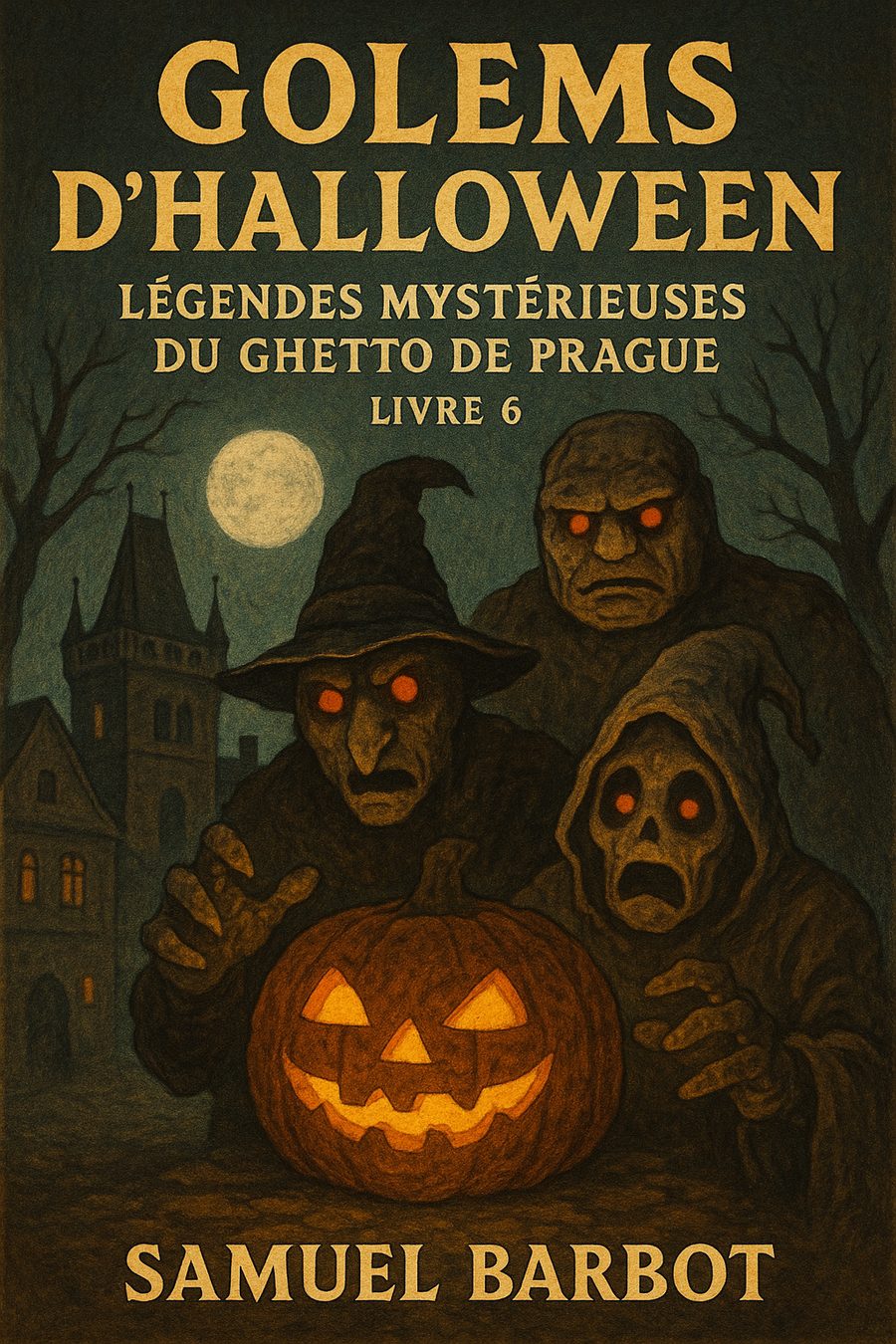
Halloween Golems
The Clay Guardian of the Prague Ghetto
Secure Stripe checkout · instant download · no subscription
See the result before you buy
This is the real player with the first three minutes of the book. Press Play: the words light up as they are read.
- Words light up one by one, the current sentence stays in view
- Voice dial: slow the narration down without making it robotic
- Pause dial: a breath after each sentence, effortless reading along
- Light or dark, larger text, your position remembered
Read and listen to the first chapter
The glass burst into a handful of black shards. One of them bit his cheek. He touched his fingers to the skin and drew them back marked with a bead of red, shining like fresh ink on parchment. On the table, the alef he had been tracing for an hour stayed unfinished, one line, tilted, that no one would complete tonight.
Grandfather Yankel sprang up, knocking his workbench over. Leather straps and needles rolled across the floor with a dry clatter. He crossed the room in three strides and pulled Léa against him before he had even looked at the gaping hole in the pane.
David did not step back. He picked up the stone, still warm from being gripped in a fist, and turned it over in his hands. A smell of smoke drifted through the broken glass, bitter, unlike the smell of wood burning in a hearth. It smelled of straw, and of something worse than straw.
"Who did that?" Léa asked, her voice full of tears but not yet fear, only the incomprehension of a child faced with a cruelty that had no face.
No one answered her right away. Yankel ran a rough thumb along Léa's arm, searching for a cut, a mark, anything that might explain the shaking of his own hands. He found nothing. She was unhurt, only afraid of the noise, and that did not reassure the old man in the slightest.
David still held the stone. There was nothing special about it, a plain river pebble, gray and cold, the kind you scooped up by the handful along the banks of the Vltava to skip across the water for fun. Tonight it weighed heavier in his palm than any scribe's tool he had ever held.
He set it down at last on the workbench, beside the scattered leather straps, rather than throw it away. He did not know why he kept it. Later he would tell himself it was to remember, but that night, in the moment, it was mostly because his fingers refused to let it go.
For two winters he had lived with Léa in their grandfather's bookbinding shop, at the end of an alley so narrow that two men could not pass without brushing shoulders. Their parents had died of fever the same week, that year, and David had sworn to himself, alone in the dark of the room they had shared, never again to let someone he loved die. He was seven years older than his sister. He often behaved as though he were seven years older than Yankel too.
The old bookbinder had ink and glue stained into his hands up to the knuckles, two colors that never washed out, and a voice that knew how to scold as well as it knew how to comfort. He raised his son's children the way he mended a damaged book: tightening each thread, one at a time, never rushing the stitch. The shop smelled of warm hide glue, old leather dust, and, that evening, something new and cold.
David, for his part, was learning to trace Hebrew letters better than any other boy his age in the ghetto. The neighborhood scribe, a dry man named Mendel, said his hand never shook over the calame, even when his heart shook plenty. It was his one admitted pride, the single thing he did better than anyone else. He did not yet suspect that this same hand would soon make him dangerous, to himself and to everything he loved.
Léa was six and feared almost nothing, except the dark beneath the stairs and the thought of losing Boutons, her wooden horse with a chipped muzzle, carved by a cousin who had gone west before she could walk. She stuck to David like a smaller shadow of his own. That night she held the horse so tightly against her that the wood left a white mark on her forearm.
"Stay with your sister," Yankel said, handing Léa to David. His own hands, meanwhile, already trembled as he pushed the bolt on the inner door.
Earlier that day, before the evening turned, David had still been a boy like any other, sitting on Mendel the scribe's low stool, copying lines of prayer onto scraps of parchment too damaged for a real book. Between corrections, Mendel had mentioned a crowd gathering near the ramparts, a man asking too many questions about who came and went from the ghetto. David had not paid much attention. A thirteen-year-old scribe had better things to do than listen to adult rumors, or so he believed then. He understood now the quiet foolishness of that thought.
Not the pace of a child at play, nor of a merchant heading home. Heavy footsteps, several of them, hammering the uneven cobbles of the alley with something urgent and wrong in the rhythm. A woman's voice was calling a name somewhere in the distance, over and over, the name of a Christian child David had already heard spoken that day, at the fountain, at the baker's, everywhere the gossips gathered in low voices.
Choose your format
Listen to chapter 1 of Halloween Golems for free
From the same collection
 7 Secrets of Modern Pleasure: The Natural Guide to Intimate Wellness & Connection
 Dia de los Muertos
 Emma and Theo - The Mysterious Attic
 Emma e Teo - La soffitta misteriosa
Organizen Editions, an independent publishing house. Books written by Samuel Barbot, a former pastry chef turned publisher; audiobooks narrated by synthetic voice, declared as such here and on every store. No subscription, no account.